Manzanillo Transmission Line
Opportunity
The Dominican Republic is in the midst of one of the most dynamic energy transformations in the Caribbean. Renewable generation capacity has nearly quadrupled since 2020, the energy sector recently overtook tourism as the country’s leading driver of foreign direct investment, and new generation projects are coming online across the country. Yet for years, the grid’s ability to move power to where it is needed lagged behind its ability to produce it. Provinces in the northwest, including Monte Cristi, Valverde, and Santiago Rodríguez, faced chronic voltage instability, grid congestion, and limited access to reliable power. These bottlenecks constrained both economic development and quality of life, even as new generation capacity was being built nearby.
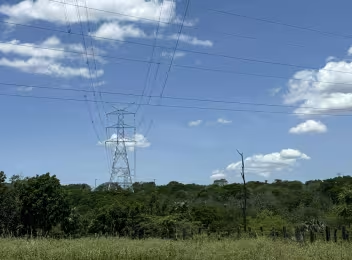
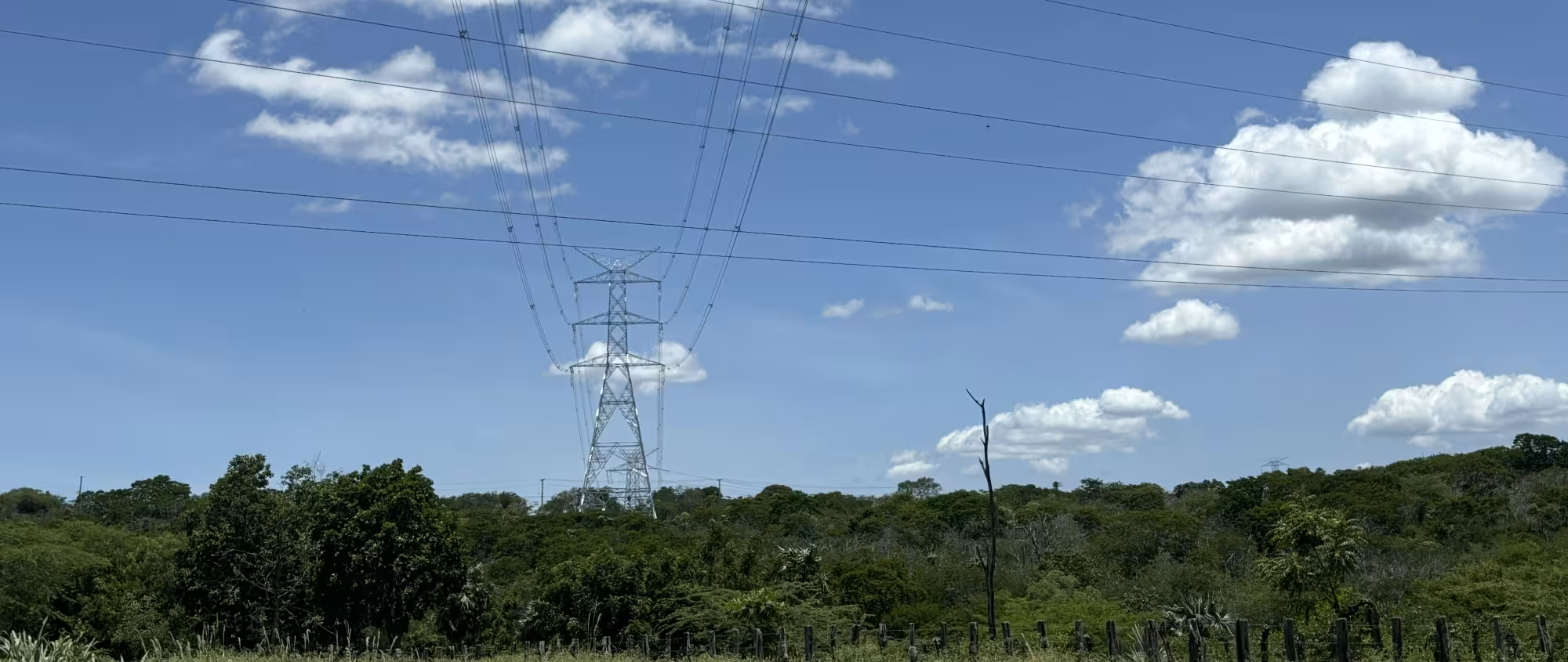
The Manzanillo Transmission Line, known locally as the Pepillo Salcedo – Guayubín – El Naranjo Transmission line, was conceived as a strategic response to this gap. Built as a 345 kV, 128-kilometer double-circuit line carried on 321 transmission towers, the project links the emerging energy hub of Montecristi to key substations and demand centers across the country. By enabling the transmission of energy from the Manzanillo gas-fired plant as well as nearby wind and solar assets, the transmission line plays a critical role in integrating an increasingly diversified energy mix into the national grid.
More broadly, the project represents a pivotal step in the Dominican Republic’s long-term energy strategy, which aims to expand the capacity of the National Interconnected Electric System (SENI) through 2028. By reinforcing the high-voltage backbone of the transmission system, it supports the country’s transition toward a cleaner, more diversified energy sources, strengthens energy security, and positions the northwest as a net generator.
Approach
To unlock this opportunity, CIFI structured and arranged up to USD 28.8 million in long-term project financing, participating directly alongside its Sustainable Infrastructure Debt Fund. The financing was developed under a conservative project finance framework, anchored in predictable cash flows derived from a reimbursement contract with Empresa de Transmision Electrica Dominicana (ETED), the state-owned transmission operator.
The structure was designed to minimize risk while ensuring long-term financial sustainability. The loan is secured by the assignment of ETED’s payment obligations under the reimbursement agreement, providing steady, dollar-denominated revenues over time. Importantly, the financing was disbursed only after the project was fully constructed, operational, and formally accepted by ETED, effectively eliminating construction and performance risk for lenders.
CIFI’s role extended beyond financial structuring. The institution coordinated a comprehensive due diligence process, including technical, legal, and environmental assessments, ensuring alignment with international standards such as the IFC Performance Standards and robust environmental and social management practices.
By combining innovative financing with rigorous risk mitigation and ESG oversight, CIFI helped deliver a bankable solution for a project that is both technically complex and nationally strategic.
Outcome
Now fully operational, the Manzanillo Transmission Line stands as a cornerstone of the Dominican Republic’s energy infrastructure. Inaugurated on July 7, 2025, ownership was subsequently transferred to ETED, ensuring long-term operational stability under the national grid operator.
Spanning 128 km, the line is now fully constructed and ready to enable the transmission of up to 1,200 MW of installed capacity as generation projects in the northwest progressively connect. Once operating at full capacity, the infrastructure is projected to support the transmission of approximately 10,512,000 MWh of electricity annually, reinforcing system stability, particularly in the northwest and north-central regions. By connecting previously underserved areas with major demand centers such as the Cibao region and Santo Domingo, the project is expected to improve access to reliable electricity for an estimated 1,370,000 people, a direct contribution to the Sustainable Development Goal (SDG) 7: Affordable and Clean Energy.
The broader impact is transformative, the project enhances the resilience of the national electricity system, reduces dependency on isolated and less efficient generation sources, and supports the country’s climate goals. During construction and testing, the project generated 372 jobs, including roles in installation, logistics, and supervision, contributing to local economic activity and skills development. With approximately 67% of the workforce comprised of local employment, the project supported income generation and inclusive economic participation along the transmission corridor, in alignment with SDG 8 (Decent Work and Economic Growth).
Beyond its technical achievements, the Manzanillo Transmission Line exemplifies how strategic infrastructure financing can drive systemic change. Through strong partnerships, sound financial engineering, and a steadfast commitment to sustainability, CIFI helped deliver a flagship project that not only powers the grid, but also advances sustainable development, laying the foundation for a more resilient, inclusive, and low-carbon energy future in the Dominican Republic.
10.5 million MWh
Projected annual energy transmission at full capacity
1.4 million people
Projected to have improved access to reliable electricity at full capacity
372
Employment generated