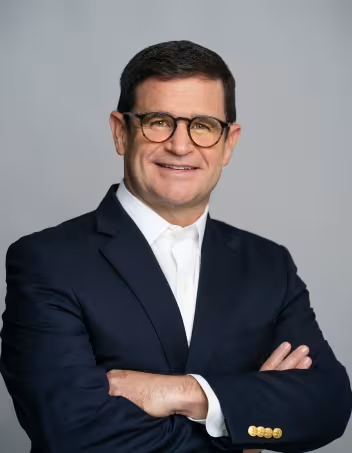

From CIFI, as an institution dedicated to infrastructure financing in Latin America and the Caribbean, we continue to analyze the trends that are transforming capital markets and the way investors access long-term assets.
In a recent internal discussion with Lya Glaentzlin, a lawyer specialized in blockchain, Web3, and Artificial Intelligence, and currently Managing Partner at the Colombian firm CLA Consultores, we explored the tokenization of real-world assets and its potential application to infrastructure. That conversation reinforced an important institutional reflection: technological innovation can create value when it is integrated with legal certainty, regulatory discipline, and structures capable of generating trust.
Tokenization is emerging as a financial modernization tool. It enables the representation of economic, financial, or ownership rights linked to assets, projects, or investment vehicles through tokens registered on secure, programmable, and traceable technological infrastructures. Its main contribution lies in complementing existing mechanisms for financing, distribution, and management of instruments.
Long-term capital and new channels
Latin America and the Caribbean continue to face a persistent need for investment in transport, energy, water, telecommunications, and logistics. These sectors require patient capital, technical capacity, and a legal architecture that allows for clear risk allocation among sponsors, financiers, investors, and authorities.
Traditional banking and capital markets have been fundamental in mobilizing resources toward infrastructure. Tokenization can add an additional layer of access, traceability, and distribution, facilitating the participation of institutional and professional investors under criteria of eligibility, compliance, and investor protection.
This potential is particularly relevant for specialized financial institutions such as CIFI, which may find in these tools new avenues to attract capital, structure investment vehicles, and channel resources toward specific projects. It may also open up alternatives to finance infrastructure directly through trusts, special purpose vehicles, funds, or other structures designed for long-term assets.
Legal architecture and operational efficiency
In regional practice, the tokenization of real-world assets typically relies on legal vehicles that hold, finance, or manage the underlying asset. Tokens may represent equity interests, economic rights, debt instruments, revenues, or contractual cash flows, depending on the corresponding legal and regulatory design.
Technology provides efficiency, traceability, and programmability. The legal structure provides governance, enforceability, transfer rules, investor protection, regulatory compliance, and clarity regarding the underlying asset. Value arises from the proper combination of both elements.
When well designed, this architecture can improve lifecycle management of instruments: payments, interest, dividends, covenants, reporting, reconciliations, secondary transfers, and monitoring of contractual conditions. For assets with long-term horizons and relatively predictable cash flows, these capabilities can reduce operational friction and enhance the experience of both investors and issuers.
Regulation and legal certainty
The institutional scalability of tokenization will depend on its interaction with robust regulatory frameworks. For infrastructure projects, the most promising structures will be those capable of operating within a regulated perimeter, with rules that are understandable for investors, trustees, custodians, auditors, regulators, and courts.
In Latin America, El Salvador offers one of the most visible examples of dedicated regulatory development. Its Digital Assets Issuance Law established a framework for public offerings of digital assets and for the role of issuers, service providers, and other market participants. This type of progress reflects a regional shift from general discussions about crypto-assets toward regimes designed for issuance, supervision, transparency, and market integrity.
Each jurisdiction will need to adapt this path to its institutional reality, its capital markets, its trust regimes, its anti-money laundering regulations, and its supervisory capacity. For infrastructure, the key will be coordinating the digital layer with registries, contracts, guarantees, permits, traditional rights, and effective enforcement mechanisms.
An agenda for the region
Infrastructure presents attractive conditions for well-structured tokenization models: long-term assets, identifiable contractual cash flows, significant capital needs, and growing interest from global investors in real and sustainable exposures. At the same time, it requires rigorous structuring due to its multiple contractual layers, local regulatory risks, physical assets, concessions, permits, guarantees, insurance, and relationships with public entities.
For this reason, the role of legal counsel and structuring teams is essential. Innovation requires legal architecture, corporate governance, robust documentation, and execution capacity. A tokenized structure will be as reliable as the clarity of the rights it represents and the quality of the institutions that supervise and manage it.
The relevant discussion for the regional market is how to leverage these tools to expand access to capital, improve efficiency, and strengthen legal certainty. Tokenization complements, with legal and regulatory discipline, the financing mechanisms of traditional banking and capital markets, providing an efficient and sophisticated channel to attract capital toward specialized financial institutions and vehicles that directly finance infrastructure projects.
For this potential to materialize, market participants, legislators, and regulators must advance clear, modern, and supervisable legal frameworks that enable the development of responsible structures within the financial system. At CIFI, we view this evolution with openness: as an opportunity to innovate responsibly, strengthen market confidence, and mobilize long-term capital toward the projects that Latin America and the Caribbean need.

Latest Perspectives



Reflections from CIFI’s CEO on Unlocking Financing for Sustainable Infrastructure in the Caribbean

Incorporating a Gender Perspective in the Impact Measurement of Energy and Infrastructure Projects